Myrna Harris
A Murder Is AnnouncedMyrna Harris is a waitress at the Royal Spa Hotel whose brief relationship with Rudi Scherz places her close to the planned hold-up without making her a knowing participant in the murder. At first she speaks defensively about him and stresses her suspicion of foreigners; later, after Inspector Craddock reassures her, she recounts how Rudi described the supposed prank and showed her the advertisement. Her testimony supplies an important distinction between knowing about a sham robbery and knowing that a real killing was intended.
Identity and First Account
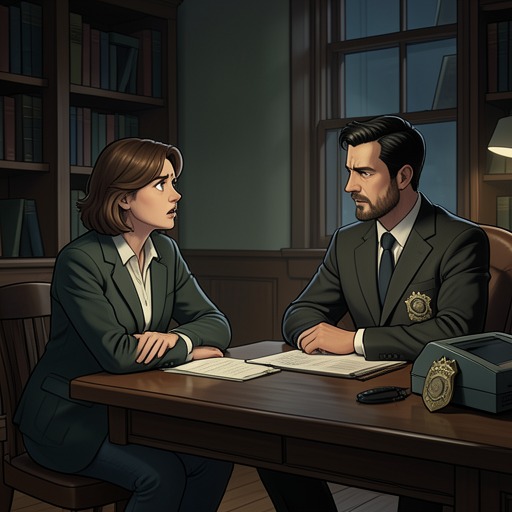
Myrna works as a waitress in the hotel’s Grill. When the police learn that she had been in Rudi’s life, Craddock decides to question her. She appears to him as a pretty young woman with red hair and a pert nose, but her manner is alarmed and wary: she feels the indignity of being interviewed and immediately insists that she knows nothing about the crime.
Her first explanation is shaped by self-protection. She says that she would never have gone out with Rudi had she known what he was like, and argues that the hotel should take greater care when employing people, especially foreigners. She speculates that he might have belonged to a criminal gang, turning suspicion outward even as the police are examining her connection to him.
Her Relationship with Rudi
Myrna describes their relationship as friendly rather than serious. She says she remained on her guard because, in her view, foreign men could be charming but unreliable; she recalls wartime Poles and Americans who concealed that they were married. Rudi, she says, talked big, but she did not take his claims at face value. Craddock notices that phrase and asks what Rudi had boasted about.
Her account presents the relationship as casual and wary, not as a deep attachment. She resents being stood up and says she does not like being let down by a foreigner, yet she is willing to make up with Rudi after their argument. The irritation matters because it explains the occasion on which he tells her about the planned escapade: his account of a lark is offered as an explanation for breaking their date and as a way of smoothing over the disagreement.
What She Knew About the Hold-Up
Myrna later apologizes for not speaking sooner. She feared that her knowledge would make her look like an accessory before the fact, and she asks Craddock to keep her out of trouble because her mother is the sort of person who worries excessively. The polished legal phrase slips easily from her tongue, but her explanation is that she had thought the plan was merely a bit of fun.
She traces the disclosure to a date at the pictures. Rudi cancelled, saying that he had a lark to attend and would not be out of pocket; he offered Myrna a wrist-watch. When she asked what he meant, he told her that there would be a party somewhere and that he was to stage a sham hold-up. He showed her the advertisement he had placed, and she laughed at it. Rudi dismissed the plan as child’s play and made a disparaging comparison with the English, prompting an argument between them before they made up.
The advertisement and Rudi’s description gave Myrna advance knowledge of a staged robbery, but not of the real violence that followed. She says that when she read what had happened—that Rudi had shot someone and then shot himself—she did not know what to do. She had believed him to be joking, would have sworn that he meant it that way, and did not even know he owned a revolver. He had never told her he would take one with him.
Testimony and Narrative Significance
Myrna’s initial denial and later disclosure form a small but consequential reversal: she is first presented as an evasive former girlfriend, then as a witness whose knowledge has a limited and specific boundary. Her account does not make her an accomplice. Instead, it clarifies that the murder advertisement and the promise of a sham hold-up had circulated as part of Rudi’s supposed prank, while the weapon and the lethal outcome were not disclosed to her.
That distinction helps separate the apparent performance from the actual crime. Myrna can explain why Rudi was absent from their date and what he claimed he would do, yet she cannot explain the shooting as something she anticipated or agreed to. Her testimony therefore contributes not merely information about Rudi but a measure of what his story concealed: the plan she heard was presented as theatrical mischief, while the real attack and Rudi’s death lay outside her understanding.